
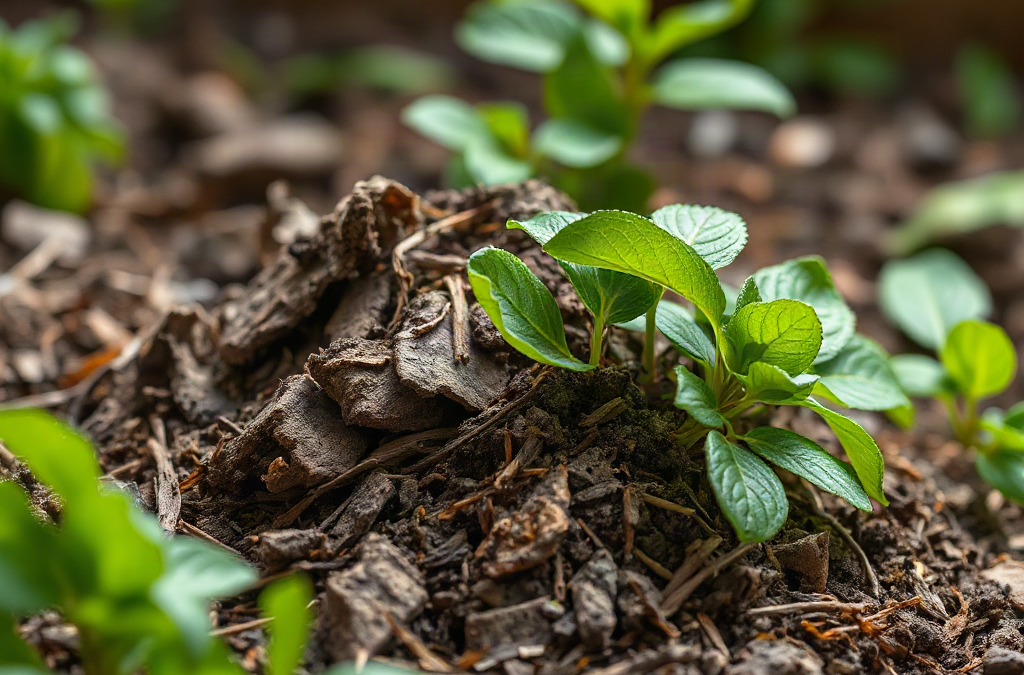
Organic compost supports productive vegetable gardening when it is fully mature, applied according to soil condition, and mixed or spread without overwhelming the root zone. Finished compost adds stable organic matter, improves water movement, and supplies nutrients gradually, but it does not replace soil testing or every fertilizer need. Use roughly 1 to 2 inches when establishing a bed and smaller surface additions for routine maintenance, adjusting for existing organic matter and crop demands. Avoid unfinished material, repeated heavy applications, and compost contaminated with persistent herbicides, excess salts, weed seeds, or animal waste that has not been properly processed.
What Makes Compost Ready for Vegetable Beds?
Garden-ready compost is dark, crumbly, cool, and earthy-smelling, with few recognizable pieces of the original ingredients. Those physical signs matter because active decomposition consumes oxygen and temporarily changes nutrient availability. Material that is still hot, sour-smelling, slimy, or dominated by intact food scraps should remain in the pile rather than being placed beside vegetable roots.

Maturity and nutrient richness are not the same. A stable compost made mostly from dry leaves may be excellent for soil structure yet contain modest amounts of plant-available nitrogen. Compost containing manures may be richer, but its nutrient and salt concentrations can vary considerably. A bag labeled as compost also may contain different proportions of bark, yard trimmings, food residuals, or manure. Read the ingredient statement when available, and treat vague promises such as “feeds all season” as less useful than a credible compost analysis.
A simple home check is to seal a moist handful in a clean container for several days. When reopened, mature compost should still smell earthy rather than putrid, vinegary, or strongly like ammonia. This is not a laboratory maturity test, but it can reveal material that needs more curing. Screening out woody chunks can make compost easier to spread, although coarse pieces are not necessarily harmful; they simply decompose more slowly and may be more useful on the surface than in a seed-starting zone.
Source quality deserves equal attention. Compost made from lawn clippings, hay, straw, or manure can occasionally contain persistent herbicide residues that survive the composting process. Before distributing an unfamiliar bulk load, mix a small sample with potting medium and grow quick-germinating peas or beans alongside a control. Twisted, cupped, or unusually narrow new growth in the test pot is a reason to stop and investigate. Normal seedlings do not prove the compost is perfect, but this comparison offers a practical warning screen.
Do not assume every homemade pile has become sanitary merely because the visible scraps disappeared. Pet feces, diseased plant debris, and weeds bearing mature seeds require handling conditions that a cool backyard pile may not achieve. Excluding questionable inputs is more dependable than hoping an uneven pile reached sufficient temperatures throughout. For edible beds, predictable ingredients and complete curing should take priority over rapid production.
How Much Compost Should a Vegetable Garden Get?
The appropriate amount depends on whether the bed is new, depleted, or already rich in organic matter. For a new bed with poor structure, a layer around 1 to 2 inches can be incorporated into the upper several inches of soil. An established bed often needs less—commonly a surface layer of about one-half inch to 1 inch—because annual heavy additions can accumulate phosphorus, soluble salts, and organic matter beyond what crops require.
| Garden situation | Practical starting amount | Application approach |
|---|---|---|
| New bed with low organic matter | About 1–2 inches | Blend into the upper soil before planting |
| Established productive bed | About 1/2–1 inch | Spread before planting or use as a surface dressing |
| Heavy clay bed | Moderate repeated additions | Avoid trying to transform texture in one season |
| Container vegetables | A limited share of the mix | Combine with materials that preserve drainage and air space |
These ranges are starting points rather than prescriptions. Soil testing provides better direction, especially where manure-based compost has been applied for several years. A laboratory soil test can identify pH, phosphorus, potassium, and other conditions that visual inspection cannot. If phosphorus is already high, adding more rich compost simply because it is “natural” may create an avoidable imbalance. Leaf compost or a surface mulch may be a more suitable source of organic matter in that situation.
Placement should match the goal. Mixing mature compost into a new bed gives it immediate contact with mineral soil, while top-dressing an established no-dig bed protects soil structure and lets earthworms and water move fine particles downward. Around transplants, spread compost across the bed rather than packing a concentrated pocket into each planting hole. A sharply different pocket can hold water differently from the surrounding soil and may encourage roots to remain in a small zone.
Timing is flexible for mature material. Compost can be spread in fall after cleanup or before spring planting, provided the ground is workable and runoff is unlikely. Applying it immediately before a severe rainstorm is wasteful on sloped or bare beds. Keep loose compost back from seedling stems and crowns, where constant moisture may favor decay.
A common mistake is measuring success by how much material was added. Productive soil is the goal, not maximum compost depth. Record the source and approximate amount each season, then compare crop growth, drainage, soil-test results, and ease of cultivation. Reduce the next application if the bed stays excessively wet, develops a surface crust rich in salts, or tests high for nutrients that compost continues to supply.
How Compost Affects Soil, Water, and Nutrients
Compost changes the root environment primarily by adding stable organic matter and feeding soil organisms. Fine organic particles help sandy soil retain water and nutrients that would otherwise move quickly below shallow roots. In clay soil, repeated moderate additions encourage aggregation, creating a more workable arrangement of particles and pore spaces. Compost does not literally turn clay into loam, and a single application cannot correct severe compaction below the cultivated layer.
Water behavior offers an early sign of progress. A treated bed should accept irrigation without immediate puddling while remaining evenly moist rather than waterlogged. In a sandy bed growing lettuce, compost may reduce the speed at which the surface dries between irrigations. In a dense clay bed planted with tomatoes, it may make the topsoil easier to crumble, but standing water after rain still points to drainage, grading, or subsoil compaction that compost alone cannot solve.
Nutrient release is slower and less predictable than with a labeled soluble fertilizer. Microorganisms gradually transform some compost nutrients into forms roots can use, and the rate changes with moisture, temperature, ingredients, and maturity. This gradual release can support steady growth, but demanding crops may still need targeted fertility based on a soil test and plant response. Pale older leaves, weak growth, or low yields should not automatically trigger another compost layer; root damage, cold soil, incorrect pH, drought, and nitrogen shortage can look similar.
Crop choice affects the practical value of compost. Leafy vegetables and long-season fruiting crops benefit from a soil that holds consistent moisture, while carrots and other direct-sown crops need a fine, mature material free of large undecomposed pieces. Fresh wood fragments mixed into the planting layer can contribute to temporary nitrogen competition as they decompose. Coarse compost is better reserved for surface use or allowed to cure longer before it goes into a seedbed.
Watch outcomes across an entire growing cycle. Positive signs include easier digging, fewer abrupt moisture swings, vigorous roots, and soil that forms loose crumbs rather than hard clods. Failure signs include persistent sogginess, ammonia odor, seedling injury, unusually lush foliage with poor fruiting, or worsening soil-test nutrient excesses. Compost should be treated as one component of bed management alongside crop rotation, mulch, appropriate irrigation, and targeted amendments—not as a universal correction for every soil problem.
Common Compost Problems and Corrections
Most compost failures in vegetable beds come from unsuitable material, excessive application, or a mismatch between the compost and the soil. The correction begins with identifying the symptom rather than automatically adding fertilizer or more organic matter. Seedlings that fail immediately after planting suggest a different problem from mature plants that grow leaves but set little fruit.
If compost smells like ammonia, sewage, vinegar, or rotten eggs, remove it from direct root contact when practical and allow it to cure in an aerated pile. Ammonia odor can accompany nitrogen-rich material, while sour or rotten odors indicate oxygen-poor decomposition. Turning the pile and adding dry, carbon-rich ingredients such as shredded leaves can improve airflow and balance, but curing takes time. Masking the odor with soil does not make immature compost suitable for roots.
White crusting on the soil surface, poor germination, or leaf-edge burn after a heavy application may indicate excess salts, particularly with some manure-based products. Stop adding the same compost, confirm the issue through soil or compost testing where available, and use irrigation carefully to move salts only when the site drains well. Leaching a poorly drained bed can worsen root oxygen problems. A lower-salt compost or leaf mold may be a better future amendment.
Unexpected distorted growth requires a cautious response. If tomatoes, peas, beans, sunflowers, or other sensitive plants develop cupped leaves after a new compost source was used, compare affected and unaffected areas and ask the supplier about feedstocks. Do not transfer suspect material to additional beds. A small plant-growth test can help distinguish a compost-linked pattern from weather injury, viruses, or pest damage, although persistent symptoms may warrant advice from a local extension service.
Use this compact check before the next application:
- Inspect maturity: confirm the compost is cool, earthy-smelling, and largely unrecognizable.
- Review the source: identify manure, yard waste, food scraps, or other main feedstocks.
- Check the bed: consider drainage, previous additions, crop performance, and recent soil-test results.
- Choose the dose: favor a modest, even layer over concentrated pockets or deep annual applications.
- Monitor the crop: note germination, leaf shape, moisture behavior, and root-zone odor.
Another misconception is that compost labeled organic automatically makes a vegetable garden compliant with organic production standards. “Organic” may describe the feedstocks informally, while certified production involves specific rules for inputs and manure handling. Home gardeners can still make responsible choices without certification, but growers selling certified produce should verify inputs through their certifier rather than relying on package wording.
The best next step after a problem is usually restraint. Pause further additions, document the source, and diagnose the bed before attempting a correction. Removing excess nutrients or contaminants is far harder than adding a modest amount later, which makes conservative application the lower-risk approach.
Frequently Asked Questions
Can vegetables be planted directly in pure compost?
Usually not. Pure compost may hold too much water, contain excessive salts, or shrink as it continues decomposing. Blend mature compost with garden soil, or use it as a measured component of a container mix.
Should compost be dug in or left on top?
Mix it into the upper layer when establishing a bed. In an established bed, surface application limits soil disturbance and works well when the compost is fine, mature, and protected from runoff.
Is compost enough fertilizer for tomatoes?
Not necessarily. Compost contributes nutrients gradually, but tomatoes may need additional fertility depending on soil-test results, compost composition, and previous amendments. More compost is not a reliable fix for every deficiency.
Can unfinished compost harm vegetable plants?
Yes. Active decomposition may create heat, unpleasant organic acids, oxygen shortages, or temporary nitrogen competition. Let unfinished material cure away from roots before using it in a planted bed.
How often should compost be added to a vegetable garden?
Many beds can be assessed once a year, but annual addition is not automatically necessary. Base the decision on soil condition, application history, crop performance, and periodic soil testing.
Conclusion
Productive vegetable beds benefit most from compost that is mature, traceable, and applied in proportion to an actual soil need. Check its smell, temperature, texture, ingredients, and—when the source is unfamiliar—its effect on a small test planting before spreading it widely. New or depleted beds may justify a deeper initial layer, while established beds usually call for lighter maintenance and periodic soil testing.
Treat drainage failures, compaction, nutrient shortages, and possible contamination as separate diagnostic questions rather than assuming another load of compost will solve them. Record what you apply and watch germination, leaf growth, moisture behavior, and harvest quality through the season. That measured approach protects the root zone from immature material, salt accumulation, and nutrient excess while preserving compost’s strongest role: building a resilient soil environment over time.
Additional Resources
Authoritative Sources
- USDA NRCS Soil Resources
nrcs.usda.govOfficial soil health, conservation, and water-management information.