
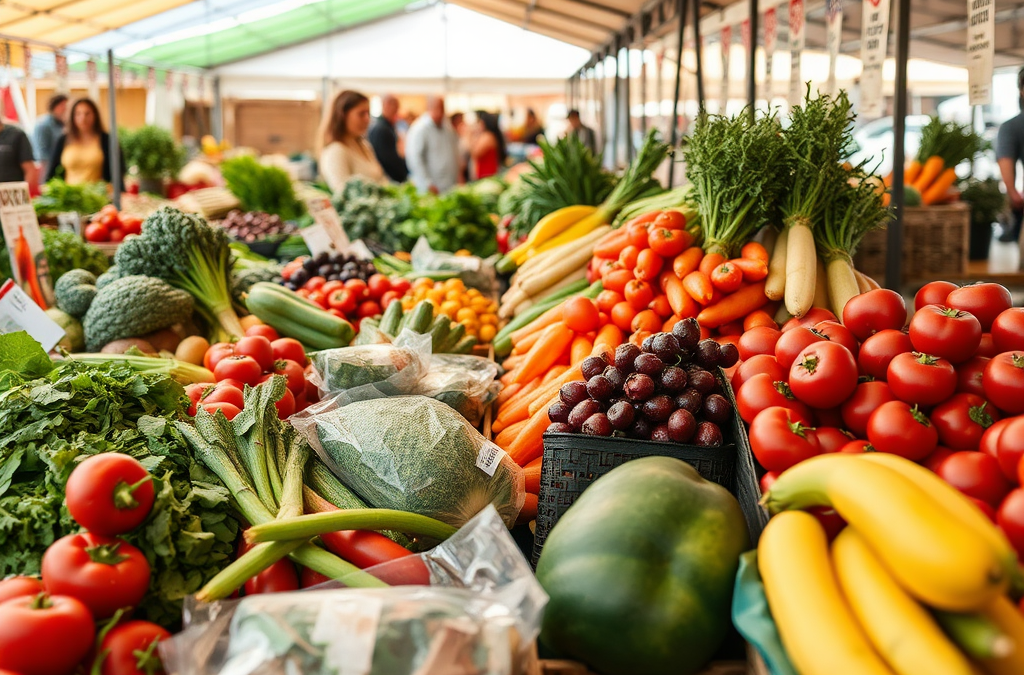
Assessing the quality of organic food at farmers' markets means verifying the farm’s organic claim, examining freshness and handling, and asking how the item was grown, harvested, and stored. Look for a specific farm name, clear answers about certification or production methods, firm produce with natural color, clean displays, and sensible refrigeration for perishable foods. Do not treat “local,” “natural,” attractive appearance, or a handmade sign as proof of organic status. Compare similar vendors, ask when the crop was picked, inspect bruising or spoilage, and keep raw animal products cold after purchase. A small farm may use organic practices without certification, so the useful distinction is between verified certification and transparent, credible production information.
Verify What the Organic Claim Actually Means
A farmers’ market sign can describe a farm, a growing method, or a marketing preference, and those categories are not interchangeable. Before judging the food itself, establish whether the seller is offering certified organic products, using organic practices without certification, or simply selling local food. “Natural,” “sustainable,” “no spray,” and “pesticide-free” may reflect sincere choices, but none of those phrases automatically establishes organic certification.
Ask the vendor to identify the farm that grew the item and explain its organic status. A certified operation should be able to name its certifier or show documentation when local market rules require it. A small producer may qualify for an exemption from certification under applicable rules, yet still follow organic production practices. In that situation, the quality assessment depends more heavily on transparent answers: what inputs are used, how weeds and pests are managed, and whether purchased ingredients are sourced from other farms.

The distinction matters because a market stall may combine crops from several sources. A vendor who grows tomatoes but resells apples should be able to tell you which farm produced each item. A mixed display is not automatically suspicious, but unclear sourcing makes the label less useful. Compare a precise answer such as “these carrots were harvested Tuesday from our certified field” with a vague statement such as “everything is chemical-free.” The first gives you traceable information; the second relies on an undefined term.
Certification also does not guarantee that every item will look perfect, taste sweet, or remain fresh. Organic rules address production and handling requirements, not a universal flavor grade. Conversely, an attractive vegetable is not evidence of compliant production. Prioritize traceability and honest communication before appearance, then use freshness and food-safety observations to complete the assessment. For readers building a repeatable shopping method, how to assess the quality of organic food at farmers’ markets begins with separating the claim from the product’s visible condition.
Read Freshness, Handling, and Display Signals
Freshness is best judged through several physical clues rather than size or cosmetic perfection. Leafy greens should look hydrated and crisp rather than limp, cut herbs should not be blackened at the stems, and firm vegetables should resist light pressure without feeling woody or shriveled. Berries and soft fruit deserve closer inspection because one leaking or moldy piece can affect nearby fruit quickly. A few blemishes may reflect normal field conditions; widespread collapse, sour odor, or wet packaging suggests a storage problem.
Harvest timing changes the value of the purchase. A bunch of greens picked recently may retain a better texture than one that has spent several warm days in transport, while a mature winter squash may be intentionally stored rather than freshly picked. Ask when the item was harvested and how it was kept afterward. The answer should fit the crop. Cool storage is sensible for leafy vegetables, but excessive condensation inside a sealed container can accelerate decay. Dry, ventilated storage may be more appropriate for certain roots or cured produce.
Handling signals reveal practical food-safety habits, although a clean table cannot prove that every step was perfect. Perishable eggs, meat, dairy, prepared foods, and cut produce should be held under appropriate temperature control. Look for protected packaging, clean utensils, separation between raw animal products and ready-to-eat foods, and a vendor who avoids touching money and food with the same unwashed hands. If a refrigerated item feels warm or has damaged packaging, ask how it has been stored and consider choosing another seller.
Do not confuse visual uniformity with higher quality. A small, irregular tomato may have excellent flavor, while a flawless item may be older or selected mainly for appearance. At the same time, “ugly” should not become an excuse to overlook mold, deep bruising, insect damage that has opened the flesh, or an off smell. A useful comparison is between acceptable field variation and active deterioration: variation affects shape or color, whereas deterioration changes texture, odor, or safety risk. Buy fragile foods in quantities you can refrigerate and use promptly rather than paying for more than your household can protect.
Ask Farmers Questions That Reveal Production Quality
Specific questions produce better evidence than asking whether food is “good.” Start with the item’s origin: “Did you grow this, and where?” Follow with timing: “When was it harvested?” Then ask about the claim: “Is this certified organic, or do you use organic practices without certification?” These questions are not accusations. They give a careful producer an opportunity to explain crop rotation, soil management, pest control, post-harvest handling, and the boundaries of what the farm actually does.
Listen for operational detail rather than a rehearsed slogan. A grower might explain that row covers are used for insect control, compost is applied according to a soil-management plan, or a crop was purchased from another certified farm. Such details do not independently verify compliance, but they show whether the seller understands the production process. Evasive answers, changing descriptions, or a sign that makes broad claims without identifying the farm should lower your confidence.
Questions should match the food. For eggs, ask about the producer, collection date when available, and refrigeration. For leafy greens, ask about harvest day and washing practices. For honey, jam, bread, or pickles, ask which ingredients are produced on the farm and which are purchased. A product made at the market may not carry the same organic status as an individual raw crop if its ingredients or handling do not meet the relevant requirements. The safest interpretation is to assess each product separately, not to assume that one credible stall makes every item equally verified.
Some shoppers avoid vendors who cannot answer technical questions immediately, but a small farmer may be busy or may not have every document at the table. A reasonable approach is to ask for the farm name, return later, check the vendor’s posted information, or contact the market manager about its verification process. That is more balanced than accepting every claim or rejecting a producer after one hurried exchange. The practical objective is confidence proportionate to the purchase: strict verification for a high-cost weekly order, and a modest test purchase when the seller is transparent but not certified.
For a deeper shopping routine, use how to assess the quality of organic food at farmers’ markets as a question-led process. A vendor’s willingness to explain sourcing and handling often tells you more than a polished banner.
Use a Market-Day Quality Checklist
A short sequence prevents attractive displays from making the decision for you. First, identify the farm and determine whether the organic description is certified, exempt, or informal. Second, inspect the item’s condition, including odor, firmness, moisture, bruising, and signs of mold. Third, ask about harvest timing and storage. Fourth, consider whether the food can be transported and stored safely once you leave. This order puts verification and safety ahead of impulse.
Use the following compact checklist when comparing two stalls:
- Source: Can the seller name the farm and distinguish grown items from resold goods?
- Claim: Is the organic status clear, and can the seller explain certification or production practices?
- Condition: Does the food have the texture and smell expected for its crop, without active spoilage?
- Handling: Are chilled or ready-to-eat foods protected, separated, and kept appropriately cool?
- Fit: Can you use the quantity soon enough to preserve quality at home?
Imagine choosing between two baskets of strawberries. Vendor A has brighter berries but cannot identify the farm and leaves several leaking berries in the container. Vendor B has slightly uneven fruit, identifies the field, gives a recent harvest day, and keeps the baskets shaded. Vendor B presents stronger evidence of quality even though the appearance is less uniform. If Vendor B’s fruit costs more, the tradeoff may still be worthwhile if the smaller quantity is more likely to be eaten before spoilage.
Home handling completes the assessment. Keep delicate produce out of a hot car, use a cooler for foods that require refrigeration, and avoid washing fragile items until you are ready to use them if excess moisture would shorten storage life. Separate raw animal products from foods eaten without cooking. Inspect purchases again at home, because damage can become visible after transport. A market’s quality cannot compensate for prolonged heat, crushed containers, or poor refrigerator placement.
The common mistake is demanding one perfect signal. Certification addresses production claims, appearance reflects condition, and temperature control addresses handling; each answers a different question. A confident decision combines them instead of using “organic” as a substitute for freshness or using appearance as a substitute for verification. That balanced method makes how to assess the quality of organic food at farmers’ markets practical under ordinary time and budget limits.
Recognize Limits, Tradeoffs, and Warning Signs
Farmers’ market shopping offers direct communication, but it does not remove uncertainty. A shopper usually cannot inspect soil records, input logs, water quality, or the complete chain of custody at the stall. Certification can provide a formal verification system, while direct buying may provide more information about harvest timing and local handling. Neither option answers every quality question by itself.
Price also requires interpretation. Certified production, small-scale labor, refrigeration, packaging, and crop losses can raise the price, but a higher price alone does not prove better quality. Compare like with like: a recently harvested organic salad mix and a long-stored conventional head of lettuce differ in more than label status. If the budget is tight, prioritize foods where freshness and storage life matter most, buy seasonal quantities, and ask whether a smaller portion is available. Spending less on food that spoils is not a saving.
Warning signs include a vendor who cannot identify the source of a supposedly farm-grown item, claims that use scientific-sounding language without explanation, visibly spoiled food mixed with saleable food, and chilled products displayed without apparent temperature control. One isolated cosmetic blemish is not equivalent to these concerns. Give greater weight to patterns: repeated evasiveness, poor hygiene, and inconsistent sourcing are more meaningful than a single imperfect vegetable.
When uncertainty remains, make a limited purchase and observe the result. Record which vendor provided good flavor, sound storage life, clear answers, and reliable handling. That personal record is useful, but it should not replace checking each seasonal product because farms change crops, staff, storage conditions, and sources. The strongest market habit is cautious trust: reward transparency, verify claims when the distinction matters, and let actual condition determine how much you buy.
Frequently Asked Questions
Does a farmers' market seller have to be certified to use organic practices?
Not every small operation is required to use formal certification under applicable rules, but certification and organic practices are not the same claim. Ask the seller which status applies and request the farm name.
Is organic produce always fresher than non-organic produce?
No. Freshness depends mainly on harvest timing, transport, storage, and handling. Ask when the item was picked and judge its condition rather than assuming the label determines freshness.
What should I inspect first at an organic food stall?
Check the source and claim first, then examine smell, firmness, moisture, bruising, and spoilage. For perishable foods, look for appropriate refrigeration and protected packaging.
Are “natural” and “pesticide-free” the same as organic?
No. Those phrases can have different meanings and do not automatically establish organic certification. Ask the producer to define the claim and explain how the food was grown.
How can I keep market purchases in good condition?
Keep chilled foods cold during transport, protect delicate produce from crushing and heat, and store each item according to its needs. Use fragile foods promptly and discard items showing active spoilage.
Conclusion
Good market decisions come from separating three questions: Was the food produced under a credible organic claim, is it fresh and sound today, and was it handled safely? Ask for the farm name, clarify certification or production practices, and inspect the item for crop-appropriate texture, odor, and signs of deterioration. Treat local, natural, attractive, or expensive as descriptive clues rather than proof. A transparent vendor with slightly imperfect but recently harvested produce may offer stronger evidence than a polished display with vague sourcing. Buy quantities that fit your storage capacity, protect refrigerated foods on the way home, and keep notes on sellers who consistently provide clear answers and dependable quality. That approach supports informed purchases without expecting an organic label to answer every food-quality question.
Huge Discount on the Best Certified Organic Nutrient Dense Supplement!

Additional Resources
Authoritative Sources
- Development and validation of a farmers' market audit tool in ...
pmc.ncbi.nlm.nih.govThe F-MAT is a reliable and valid method to assess food availability and quality at farmers' markets. The measure was sensitive in that it captured differences
- Evaluating the farmers market from a food safety perspective
canr.msu.eduIf the vendor uses manure, an application at least 120 days prior to harvest and at least two weeks prior to planting is the industry standard.


