
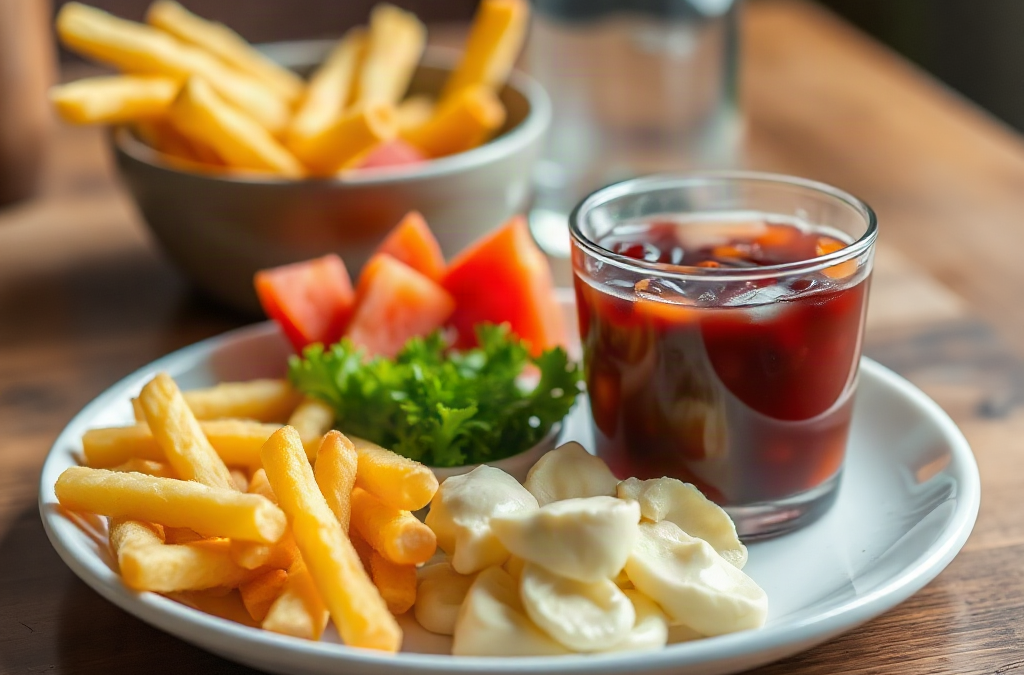
Nutrition label serving sizes and actual portions often differ because the label uses a standardized reference amount, while a portion is the quantity someone chooses to eat or drink. To calculate what you consumed, compare your portion with the listed serving size, determine the number of servings, and multiply the calories and nutrients by that amount. A two-serving package eaten at once provides twice every listed value, including sodium, added sugars, and saturated fat. Measuring occasionally, checking servings per container, and accounting for preparation can reveal discrepancies that visual estimates and package size tend to hide.
What Is the Difference Between a Serving Size and a Portion?
A serving size is the labeled quantity used to calculate the nutrition information, whereas a portion is the amount placed on a plate, poured into a glass, or eaten from a package. The serving size creates a common basis for reading calories and nutrients. It is not an instruction that every person should consume exactly that amount.

The distinction becomes clearer with cereal. A label might express one serving in cups and grams, but a large household bowl may hold considerably more. The cereal does not change nutritionally; the number of label servings in the bowl changes. If the bowl contains one and a half servings, its calories, carbohydrate, fiber, added sugars, and other listed nutrients are each one and a half times the label values. Milk and toppings must then be counted separately.
Package appearance can weaken portion judgment. A small bottle, snack pouch, or frozen entrée may look like a single unit even when the label lists more than one serving per container. The reverse can occur with products packaged as several individually recognizable pieces: the serving may include multiple pieces rather than one. The reliable starting point is therefore the combination of serving size and servings per container, not the physical package alone.
Serving sizes also should not be treated as personalized dietary prescriptions. Energy and nutrient needs vary with age, body size, activity, health conditions, appetite, and the rest of the diet. Someone may reasonably eat less than the labeled amount of a rich condiment and more than the labeled amount of a vegetable-based dish. The label remains useful because it allows the chosen portion to be translated into comparable nutrient information.
A common mistake is to compare two products only by the calories printed in bold. If one product lists a 30-gram serving and another lists 45 grams, the numbers describe different quantities. Compare equal weights, equal volumes when density is similar, or the amount you realistically use. For products such as granola and puffed cereal, grams are usually more dependable than cup measures because their densities differ substantially.
How Do You Calculate Nutrition for the Portion You Eat?
The practical calculation is: actual portion divided by labeled serving size equals the number of servings consumed. Multiply every relevant label value by that result. This method works with grams, milliliters, cups, pieces, or another unit, provided the portion and serving size use the same unit.
Suppose a snack lists a 28-gram serving and you eat 42 grams. Dividing 42 by 28 gives 1.5 servings. A label showing 160 calories, 7 grams of fat, and 180 milligrams of sodium per serving would represent 240 calories, 10.5 grams of fat, and 270 milligrams of sodium for that portion. The same multiplier applies to protein, fiber, added sugars, vitamins, and minerals.
| Actual Amount Eaten | Label Serving Equivalent | How to Adjust Each Label Value |
|---|---|---|
| Half the serving size | 0.5 serving | Multiply by 0.5 |
| Same as the serving size | 1 serving | Use the listed value |
| One and a half times the serving | 1.5 servings | Multiply by 1.5 |
| Twice the serving size | 2 servings | Multiply by 2 |
For packaged items, another useful shortcut is to multiply by servings per container when the entire package is consumed. If a bottle contains 2.5 servings, finishing it means consuming 2.5 times the per-serving values. Some labels provide an additional column for the whole package, but that presentation is not available on every product, so the servings-per-container line still deserves attention.
Preparation creates another layer. A dry pasta label generally describes a dry quantity unless it explicitly says otherwise, while the cooked portion contains absorbed water and weighs more. Dry soup mix, pancake mix, and powdered drinks may show information for the product as packaged, as prepared, or both. Added oil, butter, milk, syrup, or other ingredients do not disappear into the label calculation; include them separately unless the displayed values specifically account for the stated preparation.
Precision should match the decision. A kitchen scale is useful when a dense product is easy to overpour, when a clinician has recommended monitoring a particular nutrient, or when someone wants to calibrate an unreliable visual estimate. For ordinary meals, rounding 1.47 servings to about 1.5 is usually more practical than pursuing false precision. Repeatedly ignoring a large difference, however, can distort a food record and obscure substantial sodium, calorie, or added-sugar intake.
Where Do Label Servings and Real Portions Commonly Diverge?
The largest mismatches often occur with foods that are poured freely, eaten directly from a container, served in oversized dishes, or concentrated in a small volume. Granola, nuts, cooking oils, dressings, spreads, chips, sweetened drinks, and ice cream can all look modest while supplying multiple label servings. Their serving sizes may be easy to read but difficult to estimate accurately by sight.
Consider salad dressing. A person may drizzle it from the bottle without measuring, making the actual quantity hard to reconstruct afterward. Because dressing is concentrated, an extra spoonful may meaningfully change the meal’s calories or sodium. By contrast, eating more than a labeled serving of plain frozen vegetables changes the numbers too, but the practical concern may be different because the larger portion can add fiber, potassium, and food volume. A serving-size discrepancy is not automatically a dietary problem; its relevance depends on the food and the nutrients being monitored.
Restaurant and takeout portions create a separate constraint because their serving information may not match a packaged-food label, and mixed dishes are difficult to divide visually. A burrito, noodle bowl, or bakery muffin may be consumed as one item even though its amount resembles several familiar household portions. When exact data are unavailable, estimate the components rather than claiming precision: note the approximate grain, protein, sauce, cheese, and vegetable quantities, then use the estimate consistently.
Bulk and homemade foods require similar judgment. A jar filled from a bulk bin has no servings-per-container cue, and a family casserole does not become six equal portions merely because a recipe states six servings. Uneven cutting, ingredient distribution, and moisture loss can alter each plate. Weighing the finished recipe and the plated portion offers a more consistent method when detailed tracking is necessary, but it may be excessive for someone seeking only general awareness.
Watch for three signs that label assumptions are failing: packages routinely disappear faster than the stated number of servings, measured amounts are repeatedly larger than visual estimates, or tracked intake seems inconsistent with the quantities actually purchased and eaten. The corrective step is not necessarily permanent weighing. Measure the troublesome item a few times in the bowl, glass, or spoon normally used. That brief calibration often provides a more realistic reference than an abstract cup or gram value.
How Can You Use Serving Sizes Without Measuring Every Meal?
Selective measurement provides most of the practical value without turning every meal into an accounting task. Prioritize products for which the likely portion is unclear, the nutrient concentration is high, or the label influences a specific decision. Measuring lettuce precisely rarely changes a meal assessment as much as checking oil, nut butter, granola, or a sugary beverage.
Begin with the container and serving information before examining individual nutrients. A compact routine keeps the process focused:
- Check the serving unit. Note whether the amount is given in grams, cups, pieces, or a prepared quantity.
- Read servings per container. Do not assume one package equals one serving.
- Compare with your usual portion. Measure or weigh it once if visual judgment is uncertain.
- Apply the multiplier. Adjust the nutrients that matter to your decision rather than reciting the entire label.
- Account for additions. Include milk, oil, sauces, toppings, and other preparation ingredients when relevant.
A useful calibration method is to serve the usual amount first and measure it afterward. Pre-measuring a “correct” serving can change behavior before it reveals the normal portion. If the cereal you ordinarily pour weighs 60 grams while the label serving is 40 grams, you have learned that your standard bowl holds about 1.5 servings. You can then decide whether that amount fits the meal rather than assuming the label amount is mandatory.
Household references can maintain accuracy after calibration. Remembering where yogurt reaches in a familiar bowl or how many crackers correspond to the gram amount is faster than weighing repeatedly. These references must be product-specific when density or piece size varies. Half a cup of airy cereal is not nutritionally interchangeable with half a cup of compact granola, and one brand’s bread slice may not weigh the same as another’s.
Measurement is failing when it produces anxiety, displaces attention from overall diet quality, or demands precision that the label itself cannot provide. Packaged-food values are useful estimates, not laboratory measurements of each bite. People managing diabetes, kidney disease, food allergies, eating disorders, or another condition affected by food quantities may need individualized advice from a registered dietitian or other qualified clinician. For most readers, the priority is recognizing meaningful multiples of a serving and using that knowledge to compare products, plan meals, and interpret nutrient totals more honestly.
Conclusion
Nutrition labels become more useful when their serving amounts are treated as calculation units rather than eating instructions. First check the serving unit and the number of servings in the container. Then compare that reference with what was poured, plated, or consumed and adjust the nutrients that affect your decision.
Focus initial measuring on foods where visual estimates are unreliable or small quantity changes matter, such as oils, spreads, granola, snacks, and sweetened drinks. Confirm whether a label describes a product as packaged or prepared, and count additions separately when necessary. After measuring a usual portion several times, a familiar bowl, spoon, or piece count can serve as a practical reference. The goal is not perfect arithmetic at every meal; it is avoiding predictable undercounting and making product comparisons on genuinely comparable amounts.
Frequently Asked Questions
Is the serving size on a nutrition label the recommended amount to eat?
No. It is the reference quantity used for the listed nutrition values, not a personalized recommendation. Your appropriate portion depends on the food, the meal, appetite, nutrient needs, and health context.
What happens if I eat two servings?
Multiply every listed value by two, including calories, sodium, saturated fat, carbohydrate, added sugars, fiber, protein, vitamins, and minerals.
Should I use cups or grams to check my portion?
Grams are generally more consistent for irregular or dense foods such as cereal, nuts, and pasta. Cups remain convenient for liquids and foods that fill a measuring cup uniformly.
Does the label refer to food before or after cooking?
Check the wording beside the serving size and preparation directions. Some values describe the product as packaged, while others describe it as prepared; added ingredients may need separate calculation.
Do I need to weigh everything I eat?
No. Occasional weighing is most useful for calibrating portions that are difficult to judge or relevant to a nutrient goal. Familiar dishes and low-concentration foods often need less precision.
Further Reading
Huge Discount on the Best Certified Organic Nutrient Dense Supplement!

Related Content
- What Does Non GMO Mean Compared to Organic: Key Differences and Labeling Insights
- What to Do If Organic Food Doesn’t Fit Your Budget: A Practical Spending Plan
- The Ultimate Guide to 10 Effective Healthy Organic Meals for 2025
- Delicious Ways to Enjoy Nutrient Dense Foods
- The Ultimate 2025 Guide to Organic Nutrition for Focus That Boosts Productivity