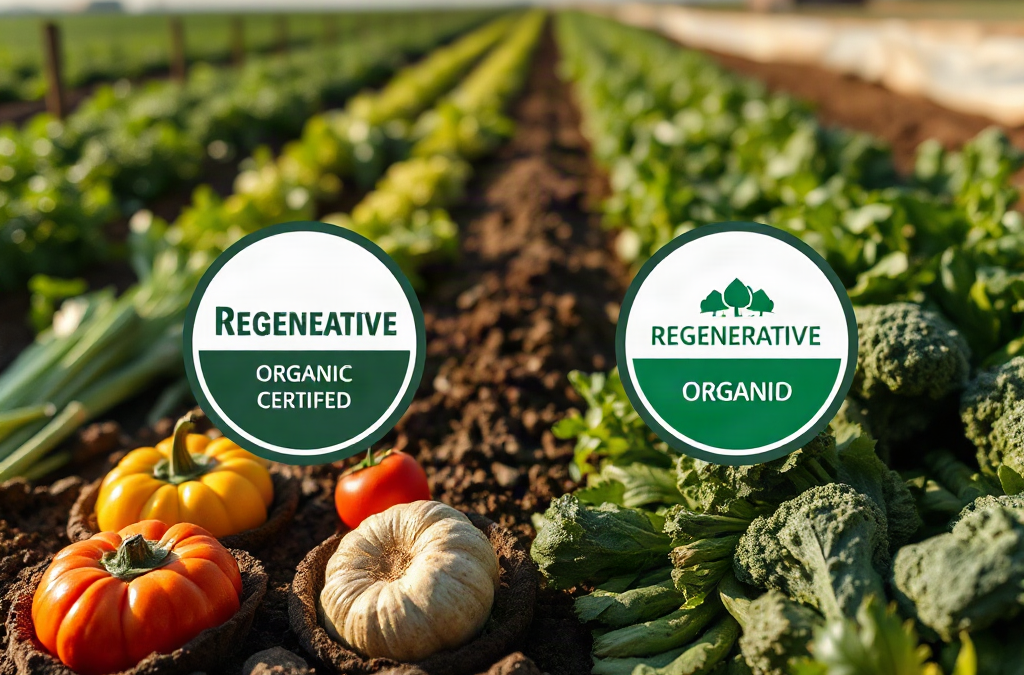
Regenerative Organic Certified and standard organic both restrict many synthetic inputs, but Regenerative Organic Certified adds requirements for soil health, animal welfare, and fair treatment of farm workers. Standard organic certification primarily verifies production and handling rules, while the regenerative standard evaluates whether farming builds soil, protects ecosystems, and treats livestock responsibly. A regenerative label may therefore provide more information about farming methods, but it does not automatically mean a food is more nutritious, fresher, or suitable for every budget. Check the exact certification mark, ingredient list, country of certification, and price before deciding whether the added standards match your priorities.
How the Two Certifications Differ
Standard organic certification and Regenerative Organic Certified certification overlap, but they do not measure the same complete set of farm outcomes. Standard organic rules generally focus on prohibited substances, approved inputs, soil-management practices, livestock conditions, processing, and the chain of custody from farm to package. Regenerative Organic Certified, often abbreviated ROC, builds on an organic baseline and adds requirements related to soil health, animal welfare, and social fairness.
The practical distinction is scope. A certified organic tomato may come from a farm that follows organic production rules, avoids prohibited synthetic pesticides and fertilizers, and maintains required records. A Regenerative Organic Certified tomato must meet the applicable organic foundation while the farm also demonstrates practices intended to improve soil function and meet additional social and animal-welfare criteria where relevant. The second label asks a broader question: not only whether certain inputs were avoided, but whether the production system is moving toward healthier land and more responsible working conditions.

Neither label should be treated as a simple ranking of food quality. Organic certification does not guarantee that a product is minimally processed, locally grown, lower in sugar, or nutritionally superior. Regenerative certification does not guarantee that every farm has the same climate, soil type, crop rotation, or measurable rate of improvement. A packaged snack can carry a meaningful production certification while still containing substantial added sugar or refined ingredients.
For shoppers comparing two similar products, the label difference is most useful as a farming-practice signal. Use the standard organic label when avoiding prohibited inputs and supporting certified organic production is your main goal. Consider the regenerative designation when soil restoration, worker treatment, and animal welfare are priorities and the product fits your budget and dietary needs. The related Regenerative organic certified versus standard organic comparison is best applied to like-for-like products rather than to completely different foods.
What Regenerative Requirements Add
Regenerative certification adds three major areas of scrutiny beyond the organic foundation: soil health, animal welfare, and social fairness. Soil requirements may involve practices such as cover cropping, crop diversity, reduced soil disturbance, compost use, managed grazing, or other methods suited to the farm. No single technique works everywhere. A cover crop that performs well in one region may compete for scarce water in another, so the meaningful question is whether the farm uses a credible system to protect and improve its soil.
Healthy soil is more than a slogan. Soil structure affects infiltration, erosion risk, root growth, microbial activity, and the ability of a field to retain nutrients and water. A farm growing cotton, wheat, or vegetables may use rotations and living plant cover to reduce the period when bare soil is exposed. Those practices can require additional planning, equipment, labor, or transition time, and results may vary by weather and location. The label signals adherence to a defined standard; it does not promise identical environmental outcomes from every farm.
Animal-welfare requirements matter most for dairy, eggs, meat, and other livestock products. The added standard may address living conditions, access to the outdoors or pasture where applicable, and responsible treatment. Shoppers should still read the product description carefully because a regenerative label on a multi-ingredient item may relate to only certain certified ingredients or supply chains. A granola containing a regenerative-certified oat ingredient is not the same as a product in which every ingredient comes from regenerative-certified farms.
Social fairness introduces another layer that conventional package comparisons often omit. Farm work involves wages, safety, housing, labor rights, and power differences throughout the supply chain. A regenerative certification that includes social requirements can make those concerns more visible, but the package still may not explain every labor condition. Ask whether the claim applies to the whole product, a named ingredient, or a specific farm. The common mistake is treating “regenerative” as a universal environmental guarantee instead of checking the certification’s actual scope.
Nutrition, Price, and Environmental Tradeoffs
Regenerative certification primarily describes how food is produced, not a guaranteed nutrient profile. A regenerative-certified bean and a standard organic bean may have broadly similar nutritional value when their varieties, processing, storage, and preparation are comparable. The important nutrition decisions remain familiar: choose whole or minimally processed foods often, compare added sugars and sodium, and consider protein, fiber, vitamins, and minerals within the whole eating pattern.
A practical example is breakfast cereal. One cereal may use organic grains, while another uses grains carrying a regenerative certification. If the second cereal has more added sugar and less fiber, the farming distinction does not erase the nutrition difference. Compare the ingredient list and Nutrition Facts panel first, then use certification as an additional purchasing value. The same reasoning applies to crackers, snack bars, yogurt, and prepared frozen meals.
Price is another real constraint. Regenerative production can involve transition expenses, more complex rotations, pasture management, documentation, separate handling, or smaller supply chains. Those costs may appear in the shelf price, although the price difference varies by product and retailer. Paying more may align with a shopper’s environmental or social priorities, but it should not force a household to reduce access to basic nutritious foods. Beans, lentils, oats, seasonal produce, and plain frozen vegetables can support a strong diet without requiring every purchase to carry the most extensive certification.
Environmental claims also require restraint. Practices that build soil may contribute to lower erosion, improved water handling, greater biodiversity, or increased resilience in some settings. They do not automatically mean a product has low transportation emissions, uses no irrigation, or stores a fixed amount of carbon. Packaging, refrigeration, land use, livestock methane, and long-distance shipping remain separate questions. Readers interested in the certification difference should avoid substituting one label for a full sustainability assessment.
How to Read the Package and Choose
Package reading works best when certification is treated as one evidence point among several. Begin by identifying whether the product carries an official certification mark or merely uses words such as “regenerative,” “soil-friendly,” or “farm raised” in marketing language. A formal certification normally has a standard, an approved certifier, and rules governing what the claim means. Marketing language may be sincere, but it can be narrower or less independently verified.
Next, determine what part of the product the claim covers. A single-ingredient food is easier to interpret than a bar containing oats, dates, oil, seeds, and flavorings. Look for wording that identifies the certified ingredient or percentage, when provided. Then compare the basic food qualities that affect your immediate goal: added sugar, sodium, fiber, protein, allergens, processing level, and serving size.
A short decision sequence keeps the comparison practical:
- Verify the claim: distinguish an official certification from an unverified environmental phrase.
- Check the scope: find out whether the certification covers the farm, one ingredient, or the complete product.
- Compare nutrition: review ingredients and the Nutrition Facts panel rather than assuming a production label predicts healthfulness.
- Assess price: decide whether the added cost fits your household priorities without displacing more important foods.
- Buy consistently when it matters: supporting a preferred standard over time may be more realistic than making every purchase at the highest price.
For example, someone choosing eggs may prioritize animal welfare and select a regenerative certification when the laying conditions and price are acceptable. Someone buying canned tomatoes may prioritize organic production, low sodium, and affordability because the regenerative option is unavailable or substantially more expensive. Neither decision is automatically superior. The failure mode is buying a certification without checking the product category, because a label cannot compensate for an unsuitable ingredient list or an unaffordable routine.
Common Misunderstandings About Both Labels
The first misconception is that standard organic means environmentally harmful or that regenerative certification makes organic certification unnecessary. Regenerative standards generally build on organic requirements rather than replacing them. Standard organic farms can use thoughtful rotations, compost, habitat protection, and erosion controls even when their products do not carry a regenerative label. The absence of the newer designation does not prove that a farm ignores soil health.
The second misconception is that regenerative food is automatically more nutritious. Farming conditions can influence crop composition, but nutrition depends on variety, maturity, storage, processing, and preparation as well. A fresh organic carrot and a regenerative-certified sweetened carrot snack are not nutritionally interchangeable. Use the production label to understand sourcing, and use the food label to judge what you are eating.
The third mistake is assuming certification answers every sustainability question. A product may meet strong soil standards while still using packaging that concerns you or traveling a long distance. Conversely, a nearby farm may use careful regenerative practices without participating in a certification program because of cost, paperwork, or market access. Direct farm information can be useful, but informal claims are not equivalent to third-party certification.
Prioritize the issue most relevant to the purchase. If avoiding prohibited agricultural inputs is the main concern, standard organic may satisfy the need. If soil restoration, animal care, and labor standards carry equal weight, the regenerative designation may offer additional assurance. Pair either choice with ordinary nutrition judgment: favor foods that fit your dietary needs, compare processing and nutrients, and treat certification as valuable context rather than a promise of perfection.
Frequently Asked Questions
Is Regenerative Organic Certified the same as USDA organic?
No. Regenerative Organic Certified builds on an organic foundation but adds requirements involving soil health, animal welfare, and social fairness.
Does regenerative certification mean a food is healthier?
Not automatically. Compare fiber, protein, added sugar, sodium, ingredients, and processing separately from the farming certification.
Does every ingredient in a regenerative-certified product have to be regenerative?
Not necessarily. Check the certification scope and product wording to see whether the claim covers all ingredients or a specific certified ingredient.
Why can regenerative products cost more?
Additional verification, transition work, diversified rotations, labor, pasture management, and separate supply chains may increase production or handling costs.
Should I choose regenerative or standard organic first?
Choose based on your priorities. Start with food quality and affordability, then select the broader regenerative standard when its added environmental and social criteria matter to you.
Conclusion
The clearest difference between the two labels is the breadth of the standard. Standard organic certification gives shoppers information about approved production and handling practices, while Regenerative Organic Certified adds a stronger focus on soil systems, animal welfare, and social fairness. That added scope can be meaningful, but it is not a guarantee of superior nutrition, lower emissions, or perfect farm outcomes.
For a practical purchase, verify the certification, check whether it covers the whole product, compare the Nutrition Facts panel, and weigh the price against your priorities. Choose standard organic when it meets your main concern and budget; choose regenerative certification when its additional requirements justify the cost and the food itself fits your needs. A thoughtful comparison produces a better decision than treating either label as a complete measure of food quality.
Huge Discount on the Best Certified Organic Nutrient Dense Supplement!